
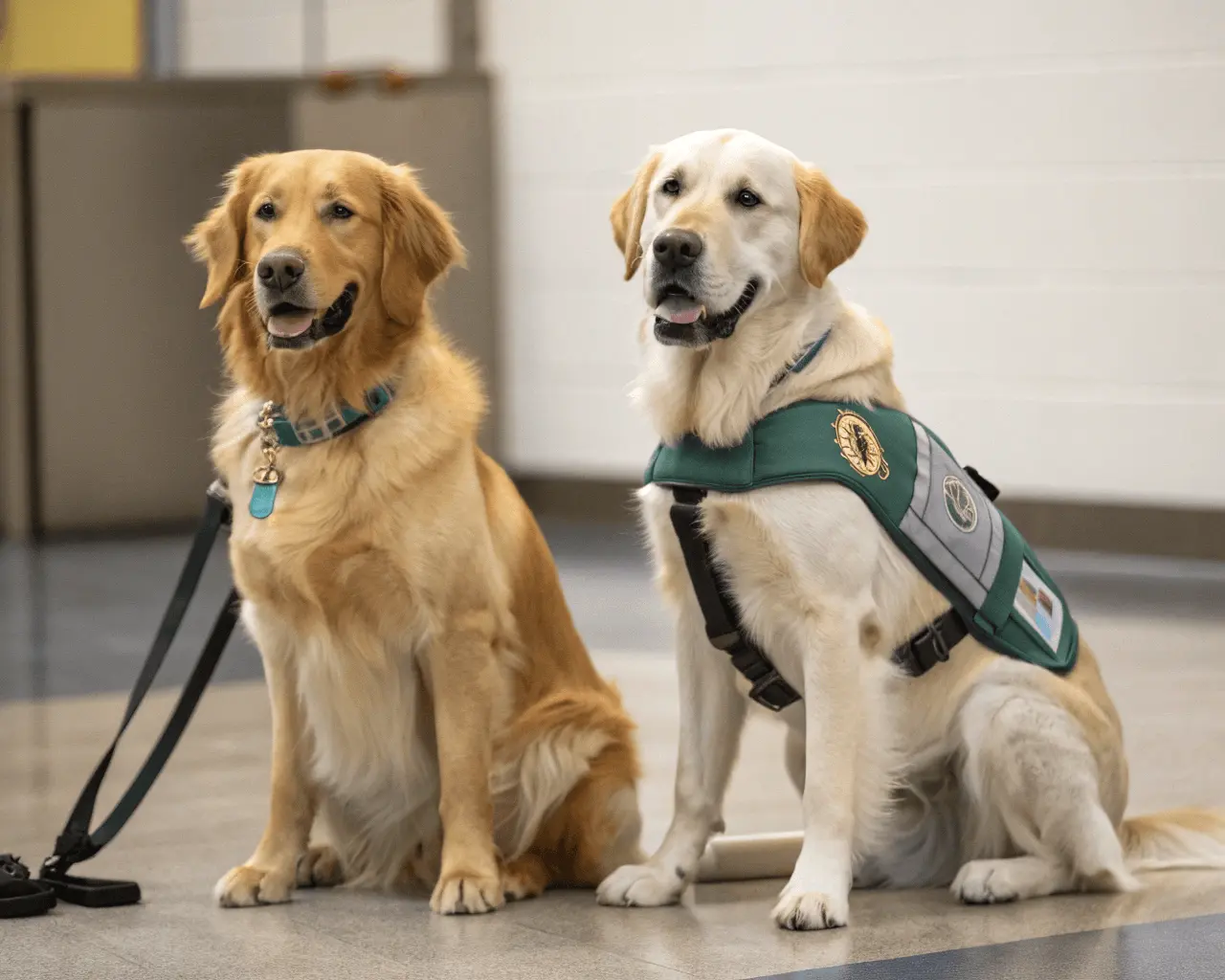
The terms “therapy dog” and “service dog” are often used interchangeably, conveniently categorized under the unofficial umbrella of “support animals.” When the lines between the two are blurred, people are left with a distorted understanding of what each actually does.
The confusion between the two isn’t harmless. It affects access rights, shapes public perception, and, most importantly, impacts people who rely on these animals for their daily functioning.
Therapy Dog vs Service Dog: Roles, Training, And Purpose
Therapy dogs and service dogs serve different purposes, even if they might appear similar to the untrained eye.
Service Dog
A service dog is trained to perform specific tasks for an individual with a diagnosed disability. These tasks help the individual or “handler” better manage their disability-related symptoms and daily life.
The exact tasks depend on their handler’s needs, but common service dog tasks include guiding someone with a visual impairment, detecting changes in blood sugar levels, or applying pressure during a panic attack.
Service dogs typically undergo intensive, task-specific training lasting anywhere between 18 and 24 months.
Therapy Dog
A therapy dog, by contrast, serves multiple people rather than just one. These dogs are not required to perform trained tasks, but instead provide comfort, companionship, and emotional relief in shared public environments such as hospitals, schools, rehab centers, or even disaster zones.
Therapy dogs are trained based on temperament and sociability, ensuring that they remain calm, friendly, and adaptable.
The Legal Divide That Shapes Everyday Life
The Americans with Disabilities Act (ADA) grants service dogs broad public access rights. It states that a service dog can accompany a handler into hotels, restaurants, grocery stores, and other public spaces.
Therapy dogs, on the other hand, do not share these same rights. Their presence in facilities is purely invitation-based and is usually coordinated by therapy organizations or institutional programs. They do not have the right to enter public spaces simply by virtue of being a therapy dog.
Much of the confusion stems from this legal divide. When therapy dogs are misrepresented as service dogs, the distinction between the two becomes less clear, making it difficult for people who genuinely rely on service dogs to navigate public spaces.
Emotional Support Is Not a Single Category
The broader framework around emotional support further complicates how these animals are understood and classified.
While therapy dogs provide comfort to groups and service dogs perform trained tasks, it is worth mentioning yet another category: emotional support animals (ESAs).
Unlike service dogs, ESAs are not required to perform specific tasks, and unlike therapy dogs, they are not typically trained for public interaction. ESAs provide emotional comfort simply through their presence, rather than through any trained or task-based behavior.
However, mental health support can extend beyond ESAs. Individuals diagnosed with conditions such as severe anxiety, depression, or post-traumatic stress disorder (PTSD) may benefit from a psychiatric service dog.
These dogs are not ESAs, but fully trained service animals that perform specific, disability-related tasks. For example, they can interrupt panic cycles, create physical space in overwhelming environments, or guide their handler to safety.
Training, Standards, and Persistent Myths
One of the most persistent misconceptions is the idea that service dogs must be officially certified or registered through a national system. In reality, what matters is not paperwork, but capability and suitability for the role.
Service dogs should be able to perform a task directly related to a disability, remain under control in public settings, and demonstrate consistent, non-disruptive behavior.
Therapy dogs, meanwhile, are often evaluated and registered through organizations that assess temperament and readiness for visitation work.
It is worth mentioning that not every well-behaved dog qualifies as a therapy dog or service dog. Both roles require focused training, consistency, and a temperament suited to the demands of their work.
Therapy Dog vs Service Dog: Why the Distinction Matters
A service dog acts as an extension of a person’s ability to function independently, while a therapy dog serves as a bridge of connection in environments that need healing.
Blurring the lines between these distinct roles not only creates confusion but also risks undermining systems designed to protect vulnerable individuals.
As awareness around mental health and disabilities continues to grow, so too does the responsibility to understand these roles. When the distinction is clear, the outcome is better for everyone: handlers, institutions, and the dogs themselves.
About the Author